
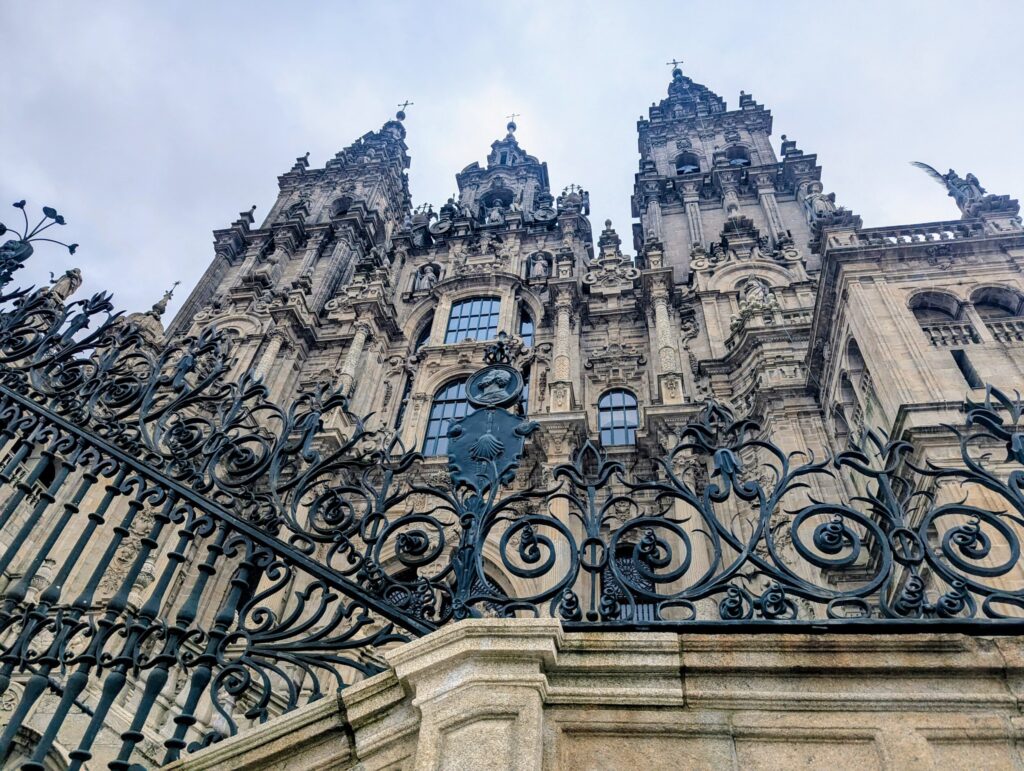
You have walked. For days, sometimes weeks. And now you are standing in Santiago de Compostela. The cathedral. The square. And then: the Pilgrim’s Office, where you collect your Compostela — the official proof that you have completed the journey.
I walk the Camino regularly myself, both solo and with groups. The Pilgrim’s Office is a place I know well. I still remember how lost I felt in 2016 after walking for 35 days and standing on that square. There were no arrows pointing the way, fellow pilgrims didn’t know either, and there you are.
For 35 days I had walked following arrows and scallop shells through a landscape I didn’t know. And here on this square, the place I had been walking towards all those days, I felt lost.
That is why I am happy to explain in this article where to go and what to expect.
What is the Pilgrim’s Office in Santiago de Compostela?
The Pilgrim’s Office, officially the Oficina del Peregrino, is managed by the Diocese of Santiago de Compostela. Here you receive the final stamp in your credencial and collect your Compostela: the Latin certificate confirming that you have completed the pilgrimage.
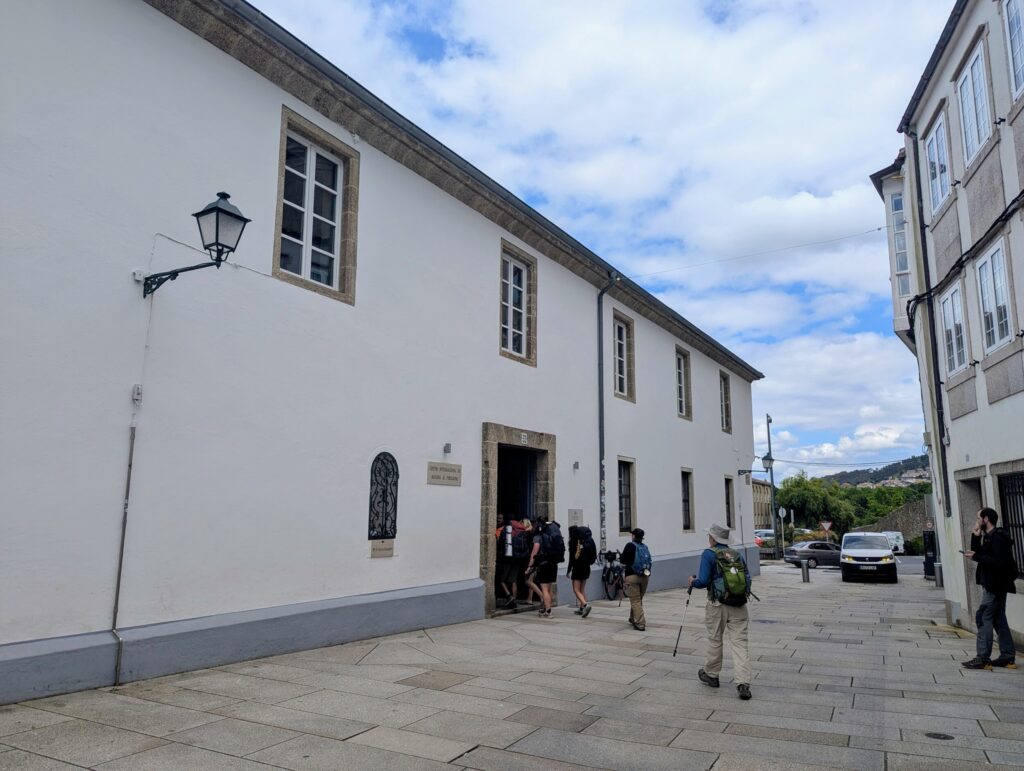
The office is located at Rúa das Carretas 33, a short walk from the cathedral and the Plaza del Obradoiro. The building covers 3,600 square metres and was renovated in 2018.
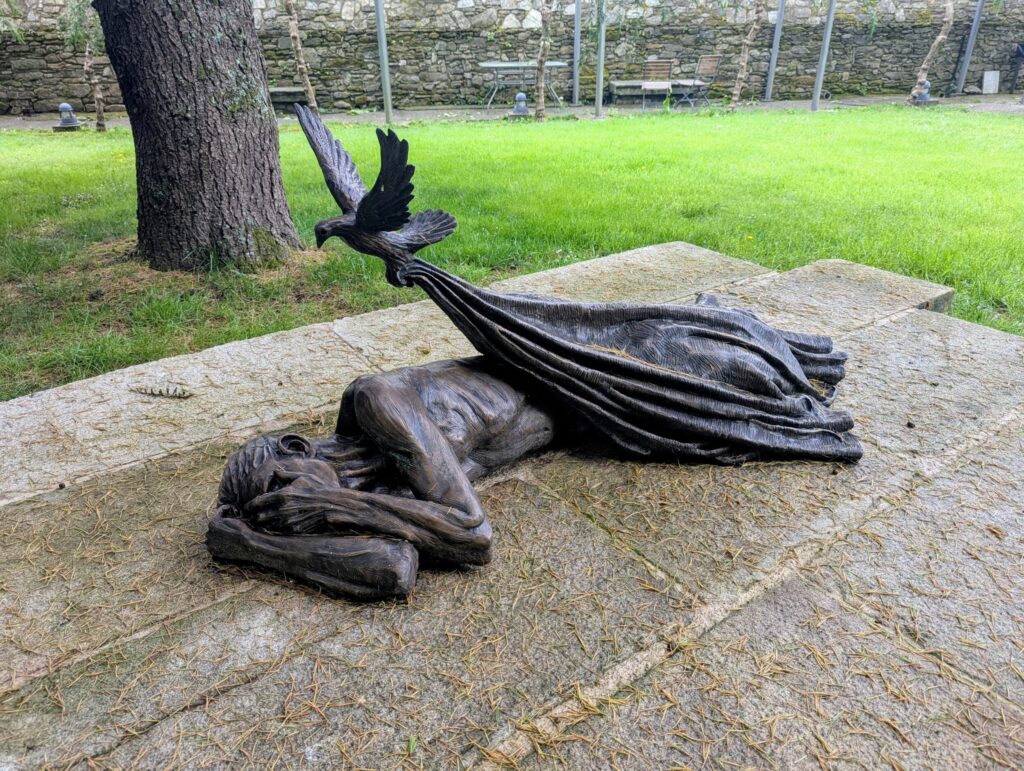
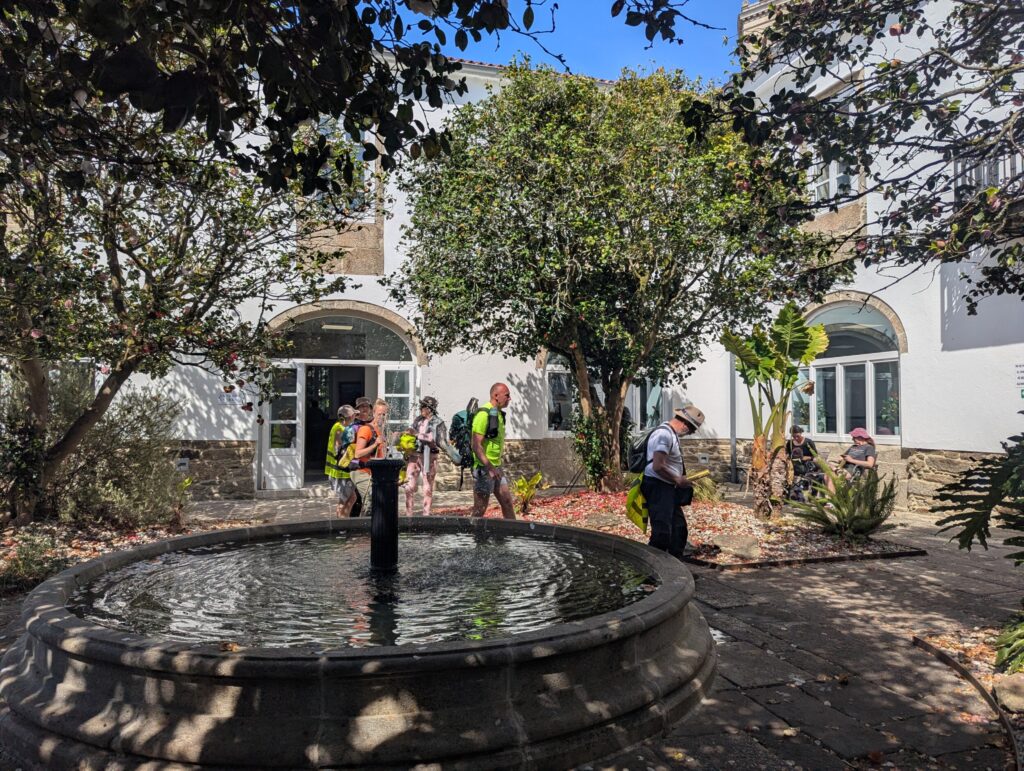
Outside is a garden where you can sit in the shade after those final kilometres. There is a statue of the Virgin Mary, and pilgrims leave items behind as silent witnesses to their journey: photos, stones with messages, and the familiar Camino scallop shell. Inside, there is a courtyard with a beautiful fountain — a quiet spot to catch your breath before heading to the desk.
What is the Compostela?
The Compostela is an official church document, written in Latin, bearing your name and confirming that you have completed the pilgrimage to the tomb of the Apostle James. It is issued free of charge.
If you walked the Camino for cultural, sporting or tourist reasons rather than religious or spiritual ones, you will not receive a Compostela but an alternative certificate, written in Spanish.
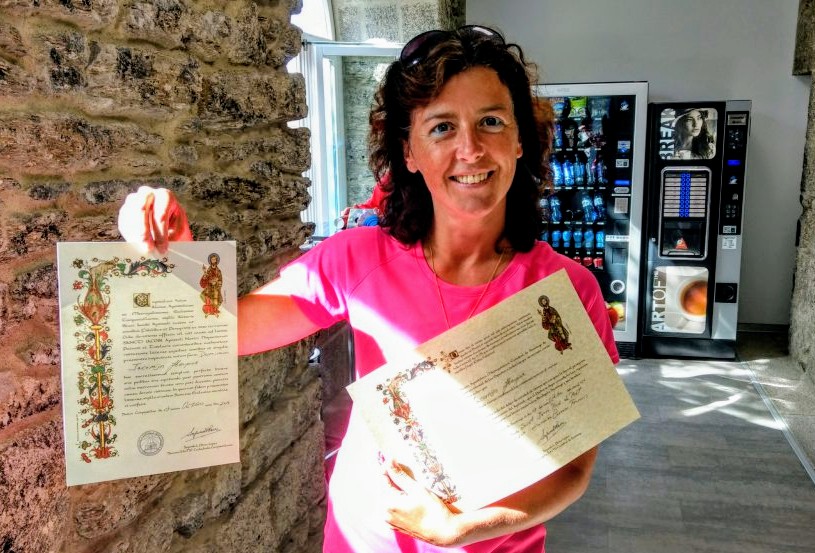
In addition to the Compostela, there is also a Certificate of Distance (Certificado de Distancia). This records your starting point, the date, the route and the number of kilometres walked. It costs €3 and is printed on parchment paper. You can request it at the same time as the Compostela.
The office also sells a protective tube to safely carry your documents home.
New rule 2025: the 100 km can be anywhere on the route
Until 2025, you had to walk the final 100 km to Santiago to qualify for the Compostela. That has changed. You can now choose any 100 km on an official Camino route. Your pilgrimage must still end in Santiago, with a final stage to the cathedral, though how long that stage must be has not been officially defined.
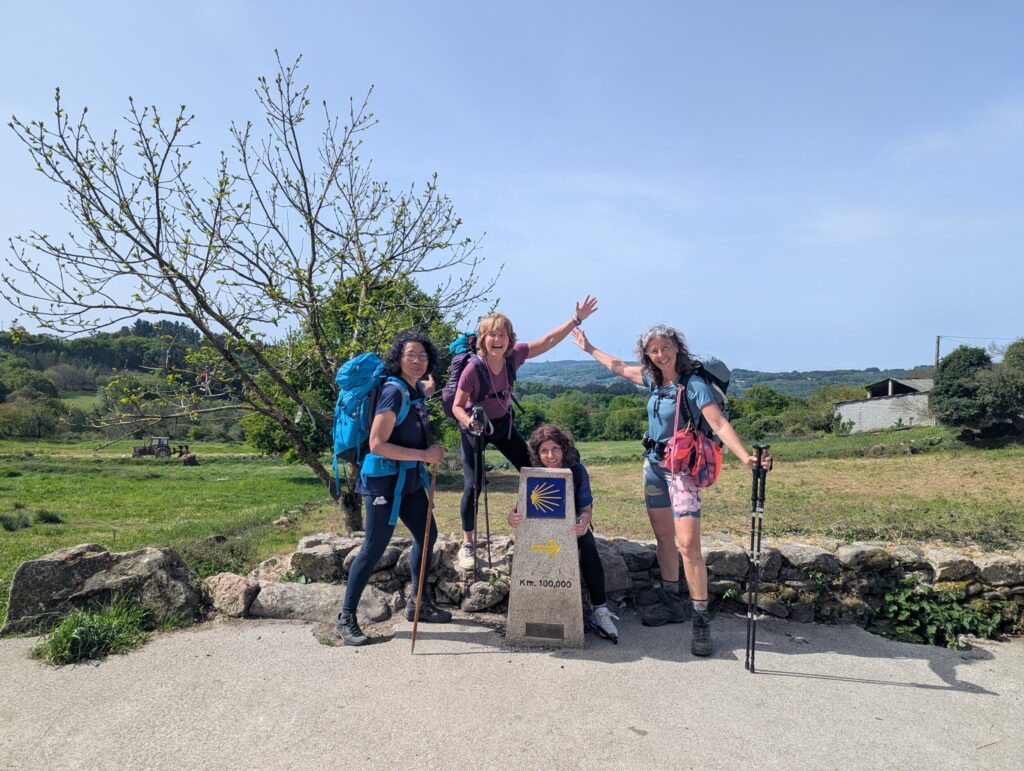
The minimum distance remains 100 km on foot or 200 km by bike. For those 100 km, the existing stamp rule applies: two stamps per day in your credencial — one at the start of the day and one later in the day or at your overnight stop.
E-bikes are excluded Pilgrims using an electric bike are not eligible for the Compostela.
Children Children who have received their First Communion or are old enough to understand the spiritual meaning of the journey can receive their own Compostela. Younger children receive a special certificate. Babies are included on the Compostela of their parent or accompanying adult.
How does collecting the Compostela work?
The process is fully digitalised. Here is how it works.
Step 1: register at the start of your journey Your pilgrim passport contains a QR code you can use to register via the website of the Oficina del Peregrino (oficinadelperegrino.com). Do this at the very start of your journey. You fill in your name, starting point, date, route and reason for the pilgrimage. That way it is done and you do not need to think about it on your final day.
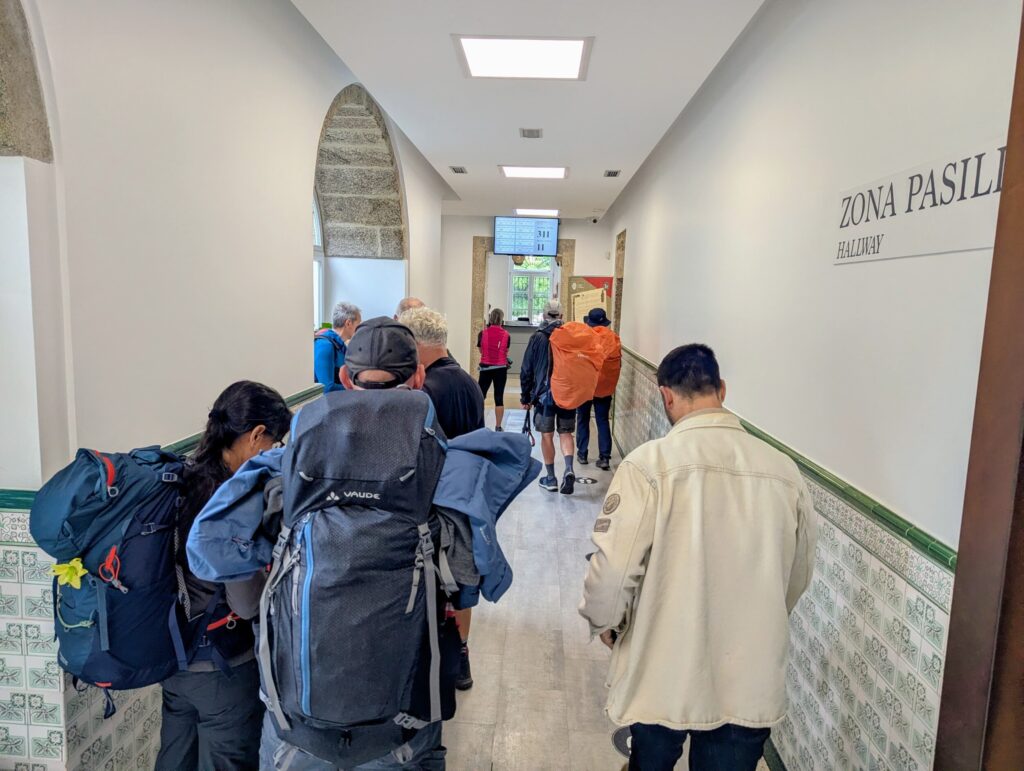
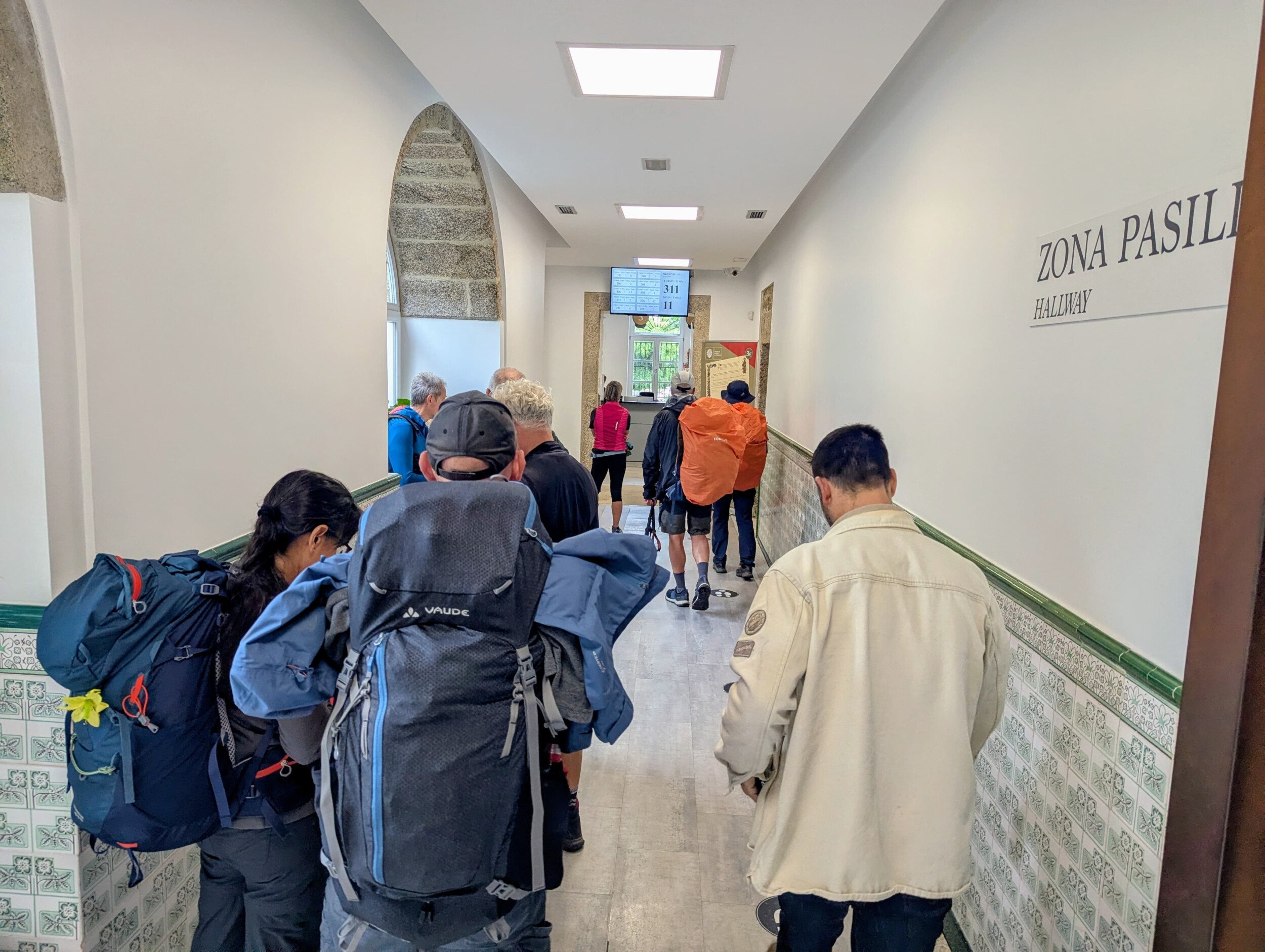
Step 2: get a ticket at the office At the Pilgrim’s Office, security staff will hand you a physical ticket with a queue number. The ticket also carries a QR code that lets you track your estimated waiting time in real time. You do not need to stand in the physical queue the whole time if it is busy.
Step 3: come back when it is your turn Waiting times have been moving quickly lately. Check the electronic boards in the corridor of the office to see when your number is called.
Step 4: at the desk Bring your credencial (pilgrim passport). The staff member checks your stamps, asks you a few questions and hands over the Compostela. The Compostela is issued in person only.
There is one exception: you can request a posthumous Compostela for someone who has passed away. Bring an extra completed pilgrim passport to the office.
Individual or group: a deliberate choice
At the Pilgrim’s Office there are separate desks for individual pilgrims and for groups (from 3 people). As a group leader you could choose to collect the Compostela as a group, but I deliberately do not do this. At the group desk the process is efficient but impersonal. Every pilgrim deserves to stand at the desk themselves, answer the questions themselves, and receive the Compostela with both hands. That moment is yours, not the group’s.
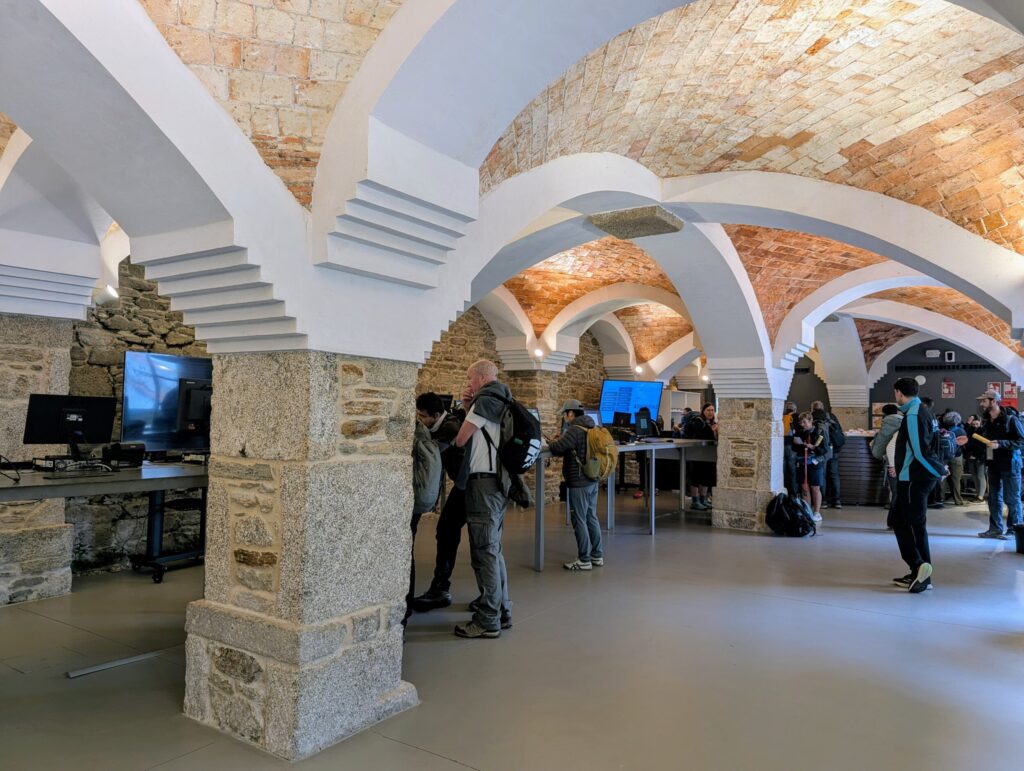
If you book with Zinvol Reizen, you always collect your Compostela individually.
What else can you do at the Pilgrim’s Office in Santiago de Compostela?
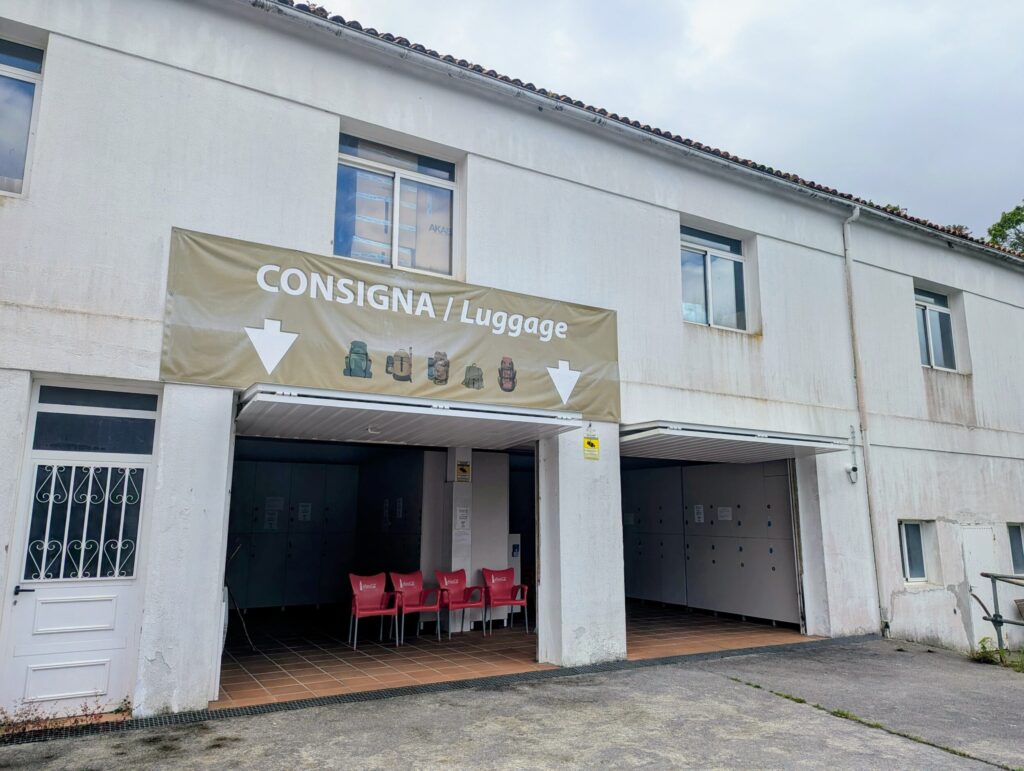
Luggage lockers At the Pilgrim’s Office you can store your full backpack in a locker. The cost is €2 and there is no time limit on use. Useful if you are continuing to Finisterre or Muxía after Santiago, and have realised you can manage with far less than you packed.
The Dutch and Flemish Pilgrims’ Corner On the first floor of the Pilgrim’s Office you will find the Huiskamer van de Lage Landen (Dutch and Flemish Pilgrims’ Corner), an initiative of the Dutch and Flemish Compostelana associations. Dutch-speaking volunteers welcome pilgrims who want to share their story. The corner is open from early April to late October, daily from 9:00 to 17:00.
A service in English At the Pilgrim’s Office you can attend a church service in English — an accessible option for pilgrims who do not speak Spanish but still want a spiritual close to their journey.
Tourist information and the Camino de Finisterre The Pilgrim’s Office also houses a tourist information desk. If you plan to continue walking to Finisterre after Santiago, you can pick up a special pilgrim passport for the Camino de Finisterre here, along with an information booklet about the route.
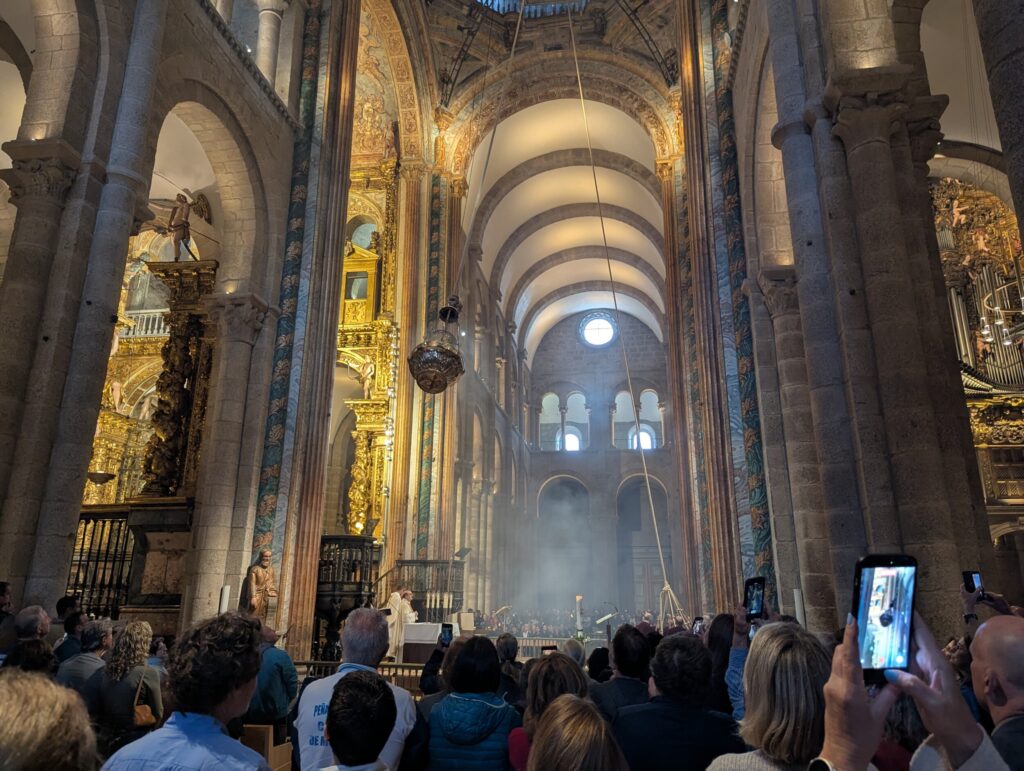
Being named in the Pilgrim’s Mass Every day the cathedral holds Pilgrim’s Masses at 12:00 and 19:30. If you would like to be named by nationality at the start of the Mass, you need to register this explicitly at the Pilgrim’s Office. Be aware: the system is not watertight. In April 2026 we found that the registration does not always come through. Do not count on it.
Practical
How to get there
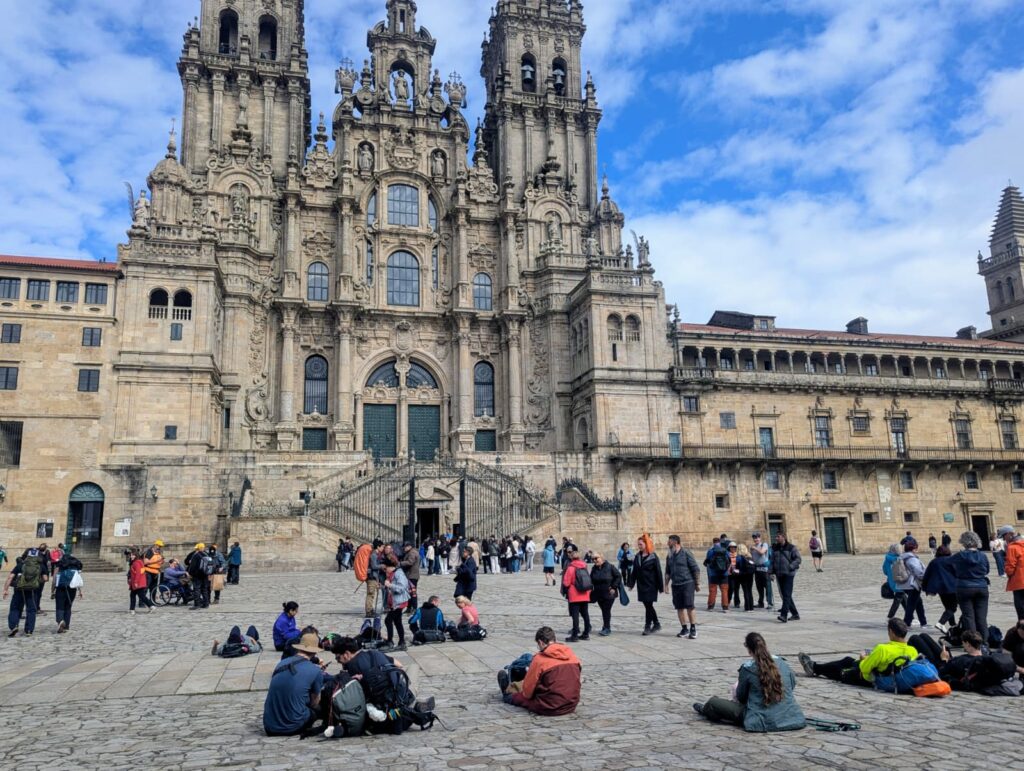
The Pilgrim’s Office in Santiago de Compostela is at Rúa das Carretas 33, a few minutes’ walk from the Plaza del Obradoiro. From the square, walk down the street below the Hostal Real de Santiago de Compostela; the office will be on your left. It is a large white building, usually with many pilgrims outside.
Opening hours
The office is open all year round. In the summer season (15 April to 31 October) it is open from 09:00 to 21:00. In the winter season (1 November to 14 April) opening hours are Monday to Saturday 10:00 to 20:00, and on Sundays and public holidays 10:00 to 14:00 and 16:00 to 20:00. The office is closed on 25 December and 1 January. On those days you can collect your Compostela from the sacristy of the cathedral.
The busiest times are in the morning and early afternoon. With the QR system you do not need to queue, but be aware that waiting times can build up during peak season.
Where to stay
Santiago de Compostela has a wide range of accommodation, from albergues to small hotels in the old town. If you plan to stay a day or two after arriving, book early — especially in high season. The streets around Rúa das Carretas are central and make a good base for your time in the city after the Camino.
On every journey I bring my own reusable water bottle #ad. My mission is to eliminate single-use plastic, and refilling rather than throwing away is one of the easiest ways to contribute as a traveller. A foldable bag #ad for small purchases also helps cut down on unnecessary plastic waste along the way.
Want to walk the Camino yourself and collect your Compostela in Santiago? I guide small groups on the first 200 km to Santiago and last 200km on the Camino Francés and the Camino de Finisterre. Take a look at the trips and join us.
Also read
- Complete Guide for Your First Pilgrimage
- Making Friends on the Camino de Santiago – The Magic of Albergue Life
- Camino de Santiago Health Tips: Complete Your Pilgrimage Healthy and Happy
- Travel Guide for Accommodation on the Camino de Santiago
- Why Collecting Stamps on the Santiago Route is So Special
This article contains affiliate links. If you book or purchase something through one of these links, we may receive a small commission at no extra cost to you.