
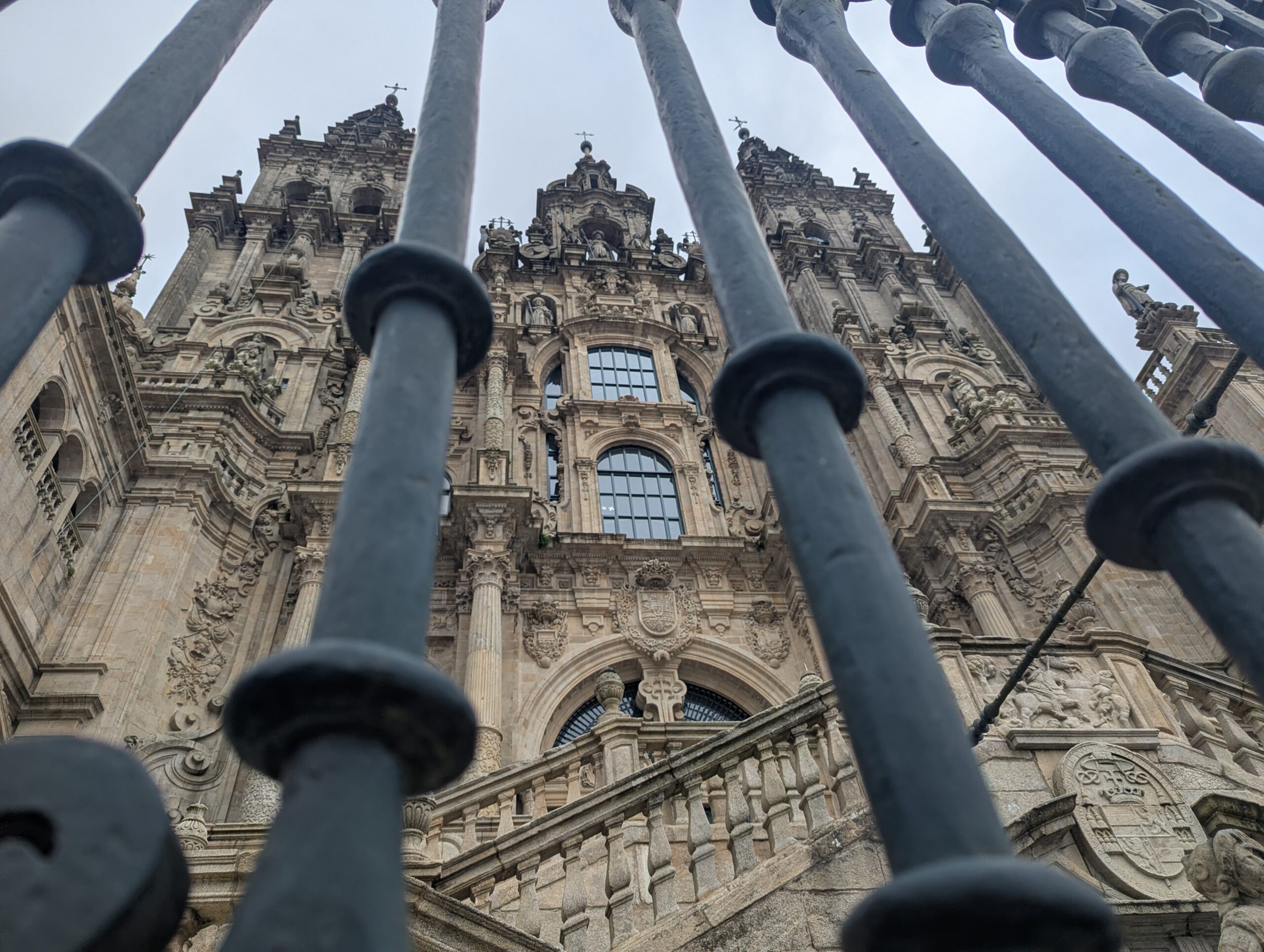
It’s the moment you’ve been walking toward. Sometimes for hundreds of kilometers. Sometimes more. And then, suddenly, you’re standing on the Praza do Obradoiro in Santiago de Compostela, the cathedral right in front of you. Tired. Happy. Full. Or empty. Often everything at once. This square is the heart of the pilgrimage, the endpoint of the Camino de Santiago, and one of the most impressive squares in Europe.
Since my first arrival in Santiago in 2016, I’ve come back here regularly. And every single time, it moves me. A wave of relief, joy, and pure release washes over this square. People come to a stop here after sometimes weeks of pilgrimage, of being in motion. That does something to a person, and so it does something to the atmosphere and energy of this vast square.
What Does the Name Obradoiro Mean?
The name gives away its origin. “Obradoiro” is Galician for workshop. During the construction of the cathedral’s baroque façade in the 18th century, stonemasons worked here on the enormous granite blocks that shaped the tower and front. The workshops themselves disappeared long ago, but the name stayed. Today, pilgrims stand on the same cobblestones where craftsmen once did their work.
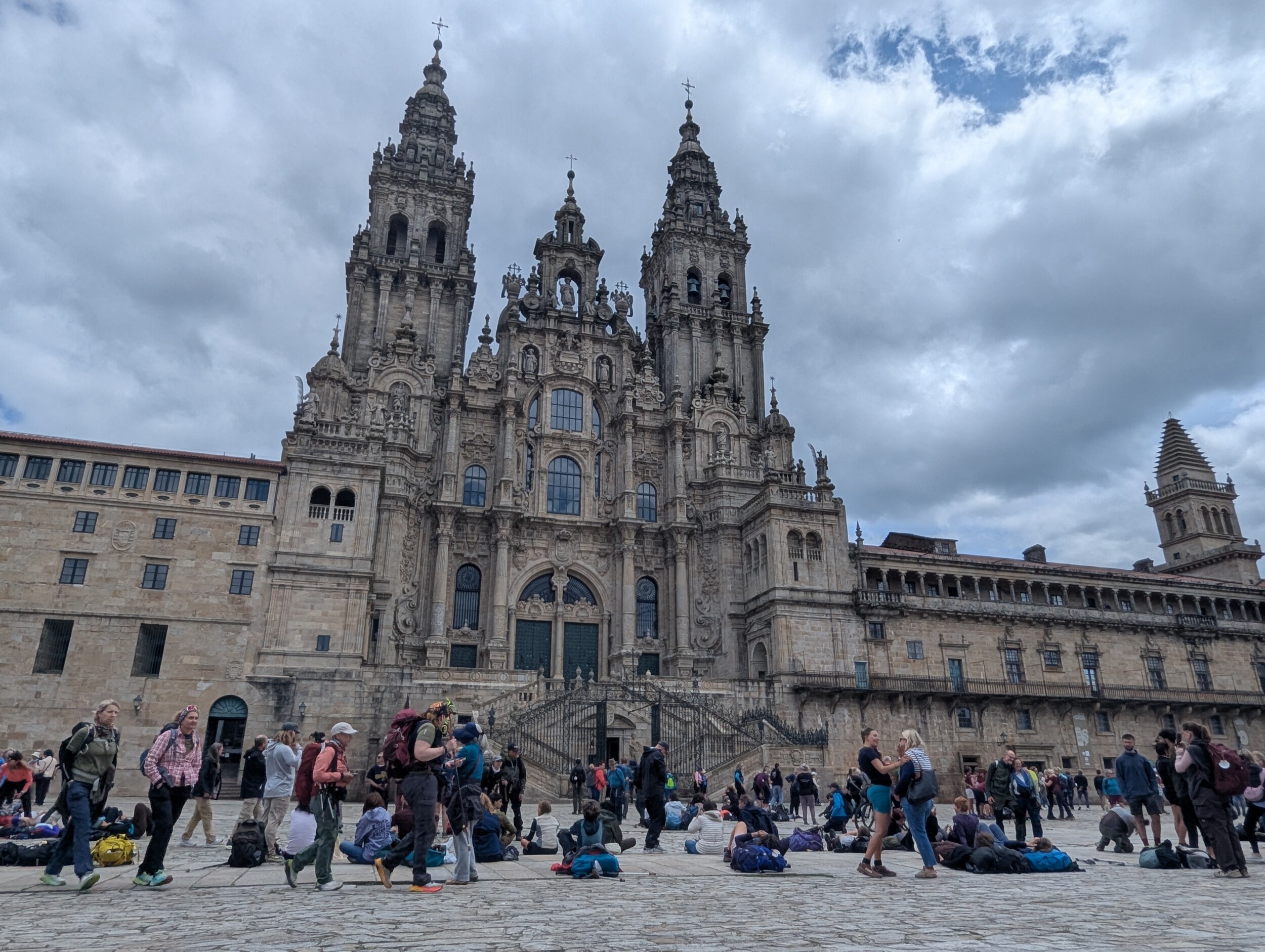
Formally, the square is the most important square in the historic center of Santiago de Compostela, even though it doesn’t sit at the exact geographic center. It’s bordered by four imposing buildings, each representing a different pillar of the city: faith, care for the pilgrim, city government, and the university. In the middle of the square lies a granite stone commemorating the Council of Europe’s 1987 recognition of the Camino de Santiago as the First European Cultural Route.
Two Routes, Two Very Different Arrivals
Arriving via the Camino Francés
If you’re walking the Camino Francés, you enter the square through a tunnel beneath the Pazo de Xelmírez. Before you even see the cathedral, you hear it: a bagpiper standing in the shadow of the archway, playing for every pilgrim who arrives. Sometimes it’s a woman, sometimes a man. More than ten players hold a permit from the Santiago municipality to play here. They take turns, arranging among themselves who plays when, keeping their schedule in a hidden spot in the stone of the arch. Only the number on the permit and their own private agreements decide who stands there at any given moment.
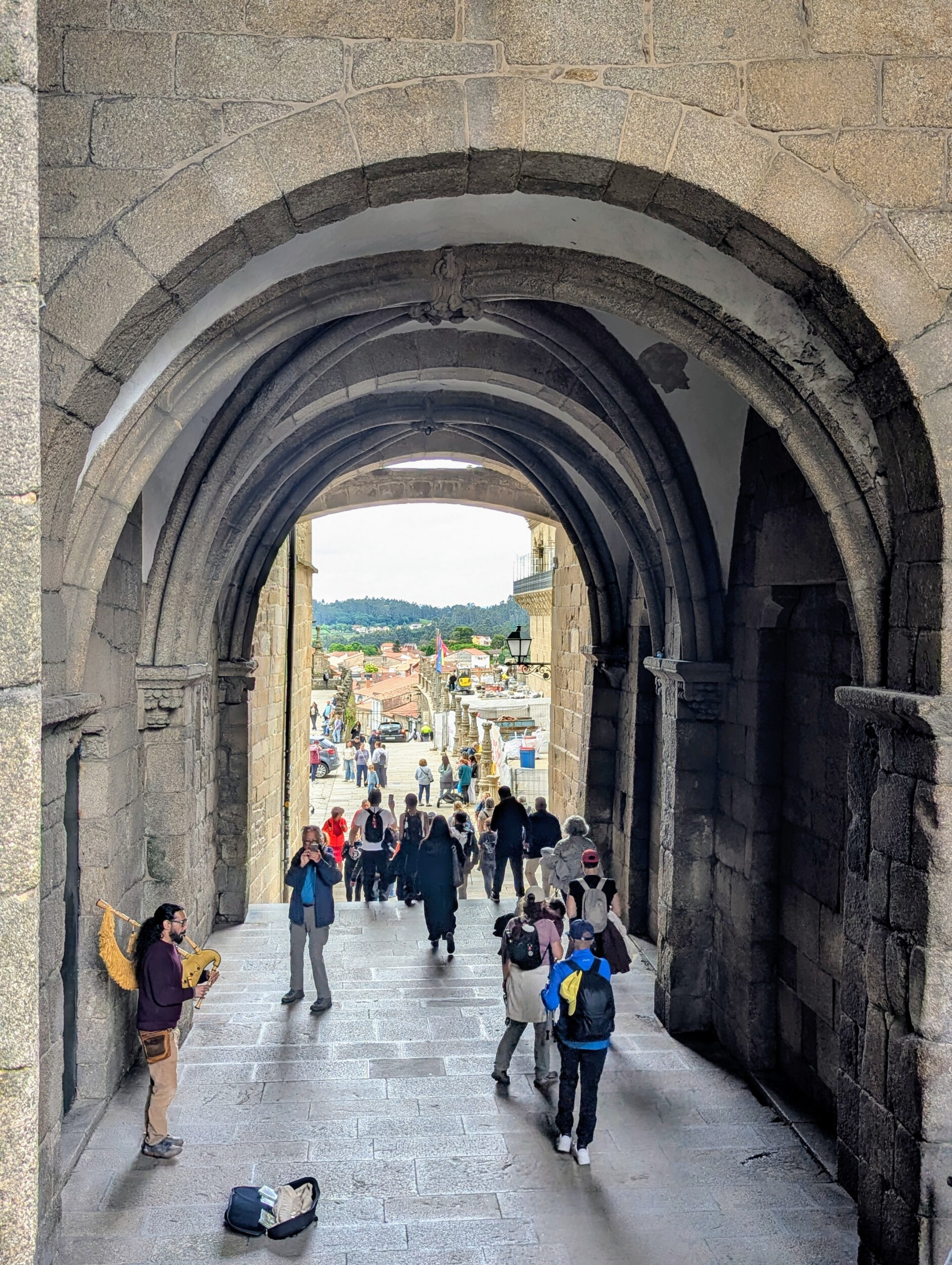
The sound of the gaita, the Galician bagpipe, is different from its Scottish cousin. Rounder, a little less sharp. It sounds old. It sounds like coming home, even the first time you hear it.
Then you take the final step onto the great square. The cathedral fills your view. Backpacks come off. Tears come. Hugs. People lie down on the ground, stretch their arms out, let out a shout, or just stand there in silence. Every arrival is different, and yet instantly recognizable to anyone who has lived it themselves.
Arriving via the Camino Português
Those walking the Portuguese Camino enter the square from a different direction: via Rúa do Franco, the busy shopping street lined with restaurants and souvenir shops. The transition is abrupt. One moment you’re walking past tapas bars and fridge magnets, the next you’re standing on one of the most monumental squares in Europe. No tunnel, no gradual build-up. The cathedral is simply there.
That directness has its own power. No crescendo, no drumroll. Just arriving.
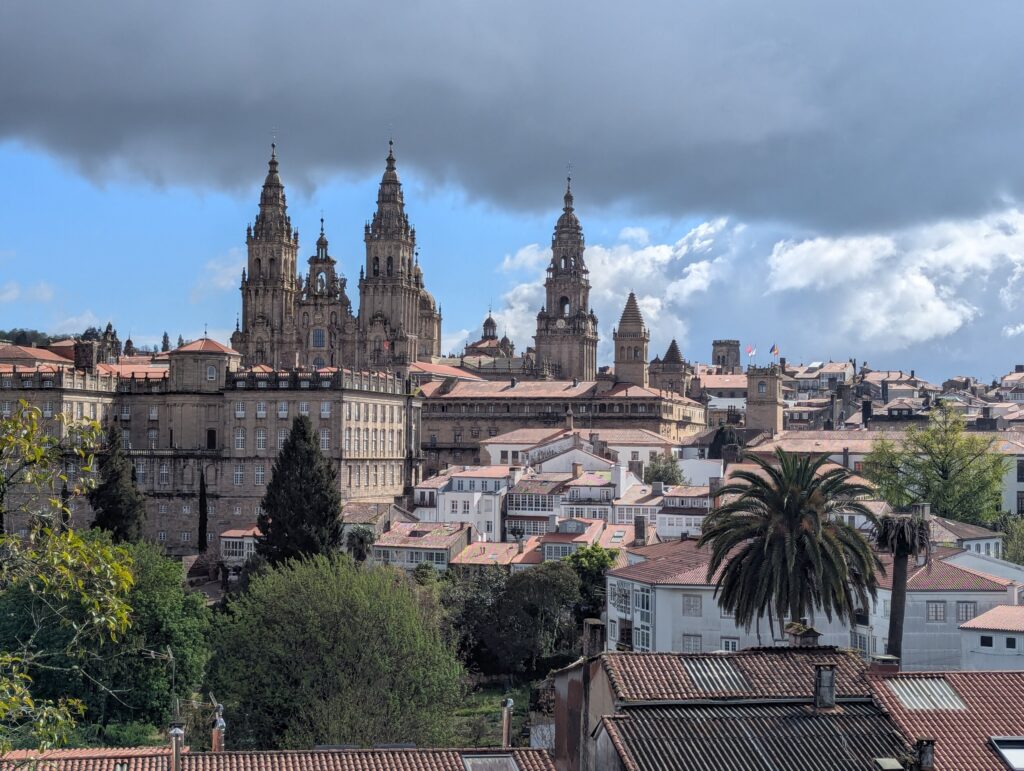
The Four Buildings Around the Square
The square is framed by four monumental buildings. They’re not there by accident. Each represents one of the four forces that have shaped the city for centuries.
The Cathedral of Santiago de Compostela (East)
The center of everything. The cathedral was built above the supposed grave of the apostle James, whose remains were said to have been discovered in the 9th century by a shepherd who saw a star shining over a field. A church grew around that grave, then a larger church, and eventually the cathedral that stands there today.
Construction began in 1075 in Romanesque style. The famous west front, the Obradoiro façade, was only added in the 17th and 18th centuries in front of its Romanesque predecessor, like a grand baroque curtain. Get closer and you can see how detailed the stonework is: angels, apostles, ornaments, all carved from the soft Galician granite that takes on an almost golden hue in the late afternoon light.
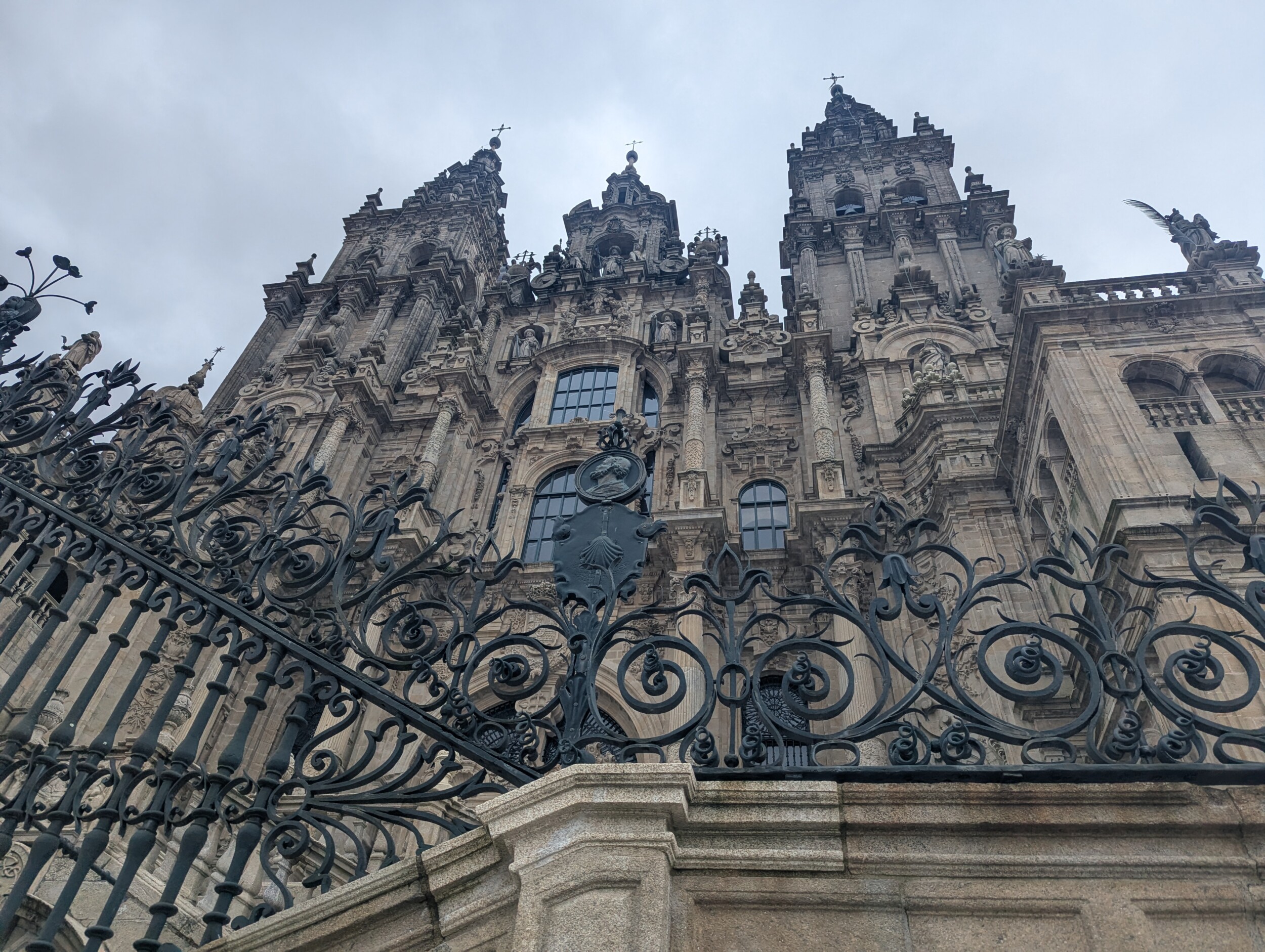
The large Praza do Obradoiro in front of the cathedral is a fixed gathering point for pilgrims. You’ll see rows of backpacks lined up, people stretched out on the ground, small groups taking photos together. It’s an incredibly lively square.
Hostal dos Reis Católicos (North)
The building on the north side of the square has a remarkable history. Queen Isabella I of Castile and King Ferdinand II of Aragon made a pilgrimage to Santiago themselves in 1486. What they found was troubling: exhausted, sick pilgrims gathering at the church doors with nowhere to go. They decided to build a royal hospital right next to the cathedral, funding the project in 1499.
Construction started in 1501 and took over ten years. Architect Enrique Egas was commissioned to design the building in Plateresque style, with four courtyards named after the four evangelists: Matthew, Mark, Luke, and John. Pilgrims could stay for a 3 days after arrival, free of charge, as long as they could show their Compostela as proof of their journey.
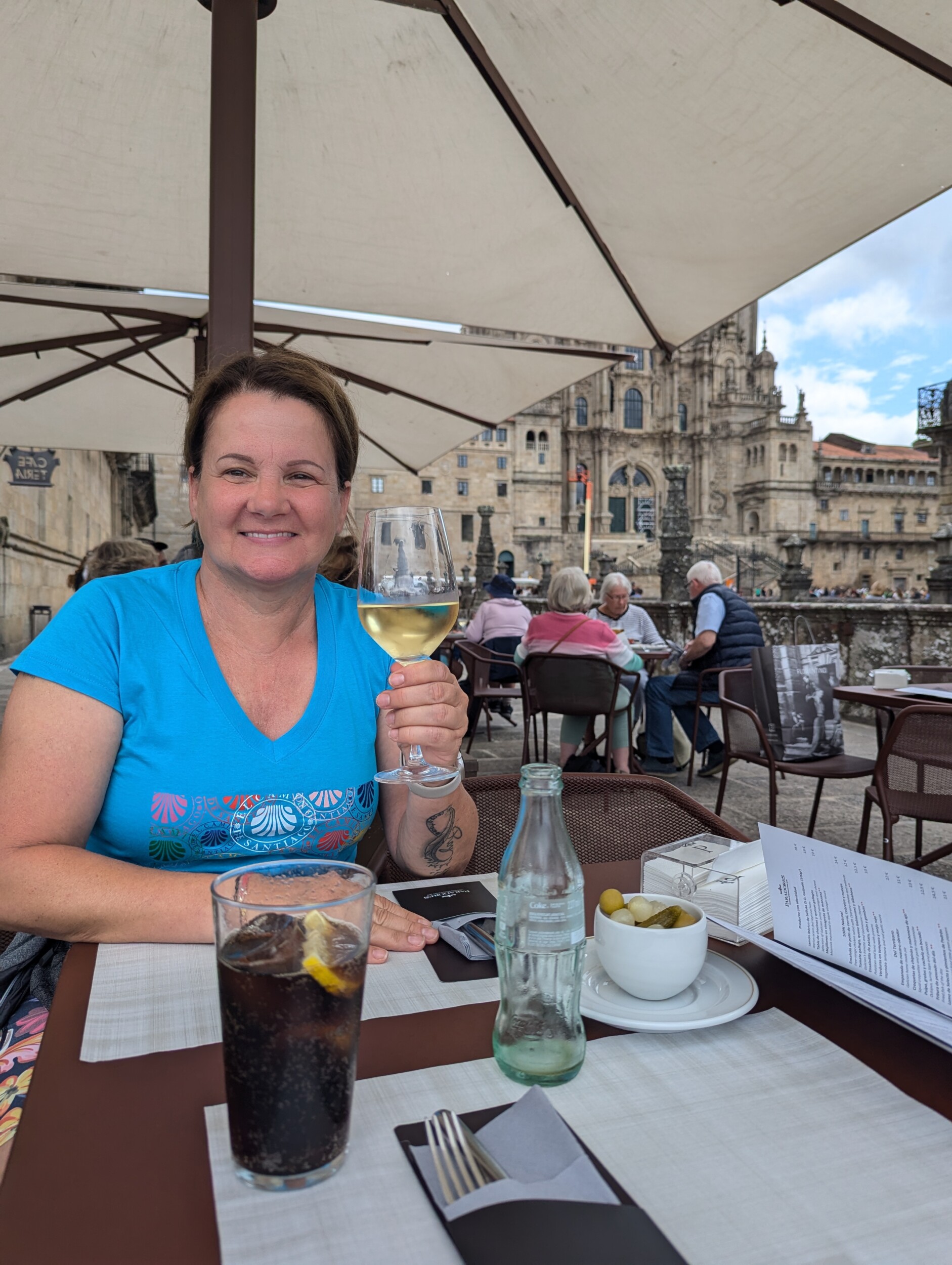
That remained the case until 1953, when hospital services moved elsewhere, and in 1954 the building reopened as a five-star hotel as part of Spain’s Parador network. To this day, the hotel offers free breakfast, lunch, and dinner to the first ten pilgrims each day who can show their Compostela. Everyone else pays five-star rates.
Not staying as a guest? You can still take a look inside: the four courtyards and the chapel are open to visitors.
Pazo de Raxoi (West)
The longest building on the square stands on the west side, directly facing the cathedral. Pazo de Raxoi is a neoclassical palace, designed by French engineer Charles Lemaur and commissioned by Archbishop Bartolomé Raxoi Losada in 1766. The building was meant to serve as a seminary for confessors, housing for choirboys and priests, and also as a prison and city hall, several functions under one roof.
The façade stretches nearly 90 meters and is dominated by a triangular pediment featuring a relief of the Battle of Clavijo, a legendary battle in which the apostle James is said to have ridden into combat against the Moors. On top stands an equestrian statue of Santiago Matamoros, made by sculptor José Ferreiro.
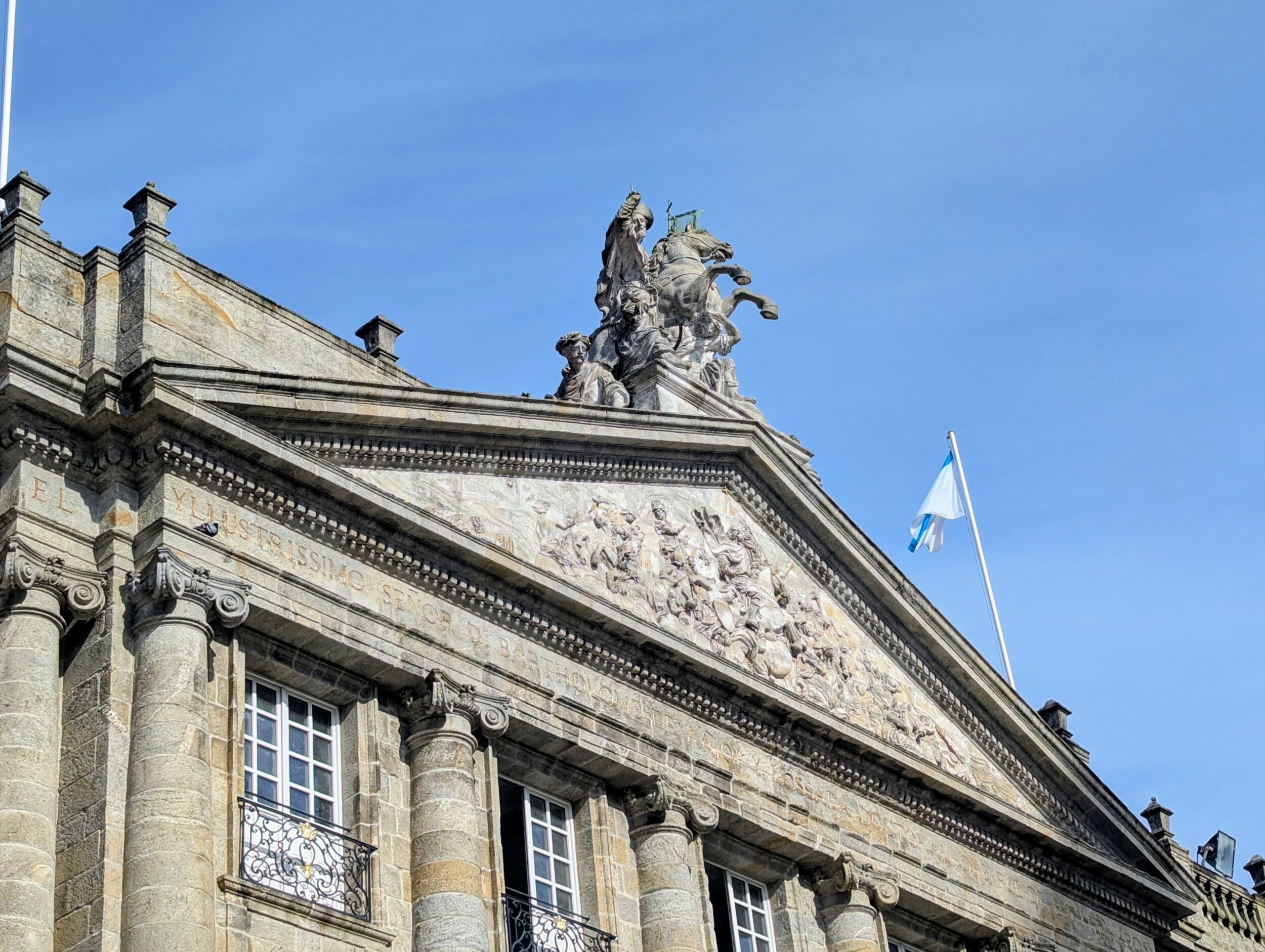
Today the building houses Santiago’s city council and the seat of Galicia’s regional government. You can’t go inside as a visitor, but the arches at the front are public. And those arches take on a special role every evening after 9pm.
Music Under the Arches
As pilgrims and tourists cross the square in the evening, musicians spontaneously start playing beneath the arches of the Pazo de Raxoi. Men in traditional Galician dress, singers, instrumentalists. This isn’t an organized concert with tickets. It just happens, evening after evening. The square as a stage, the arches as an acoustic bowl, and everyone walking past as the audience.
Colexio de San Xerome (South)
The smallest and most modest building on the square is the Colexio de San Xerome. It was founded in 1501 by Archbishop Alonso III de Fonseca as a school for poor art students hoping to move on to university. It originally stood elsewhere in the city, but when Benedictine monks from the nearby monastery bought the property to expand their monastery, the school moved to its current location on the Praza do Obradoiro.
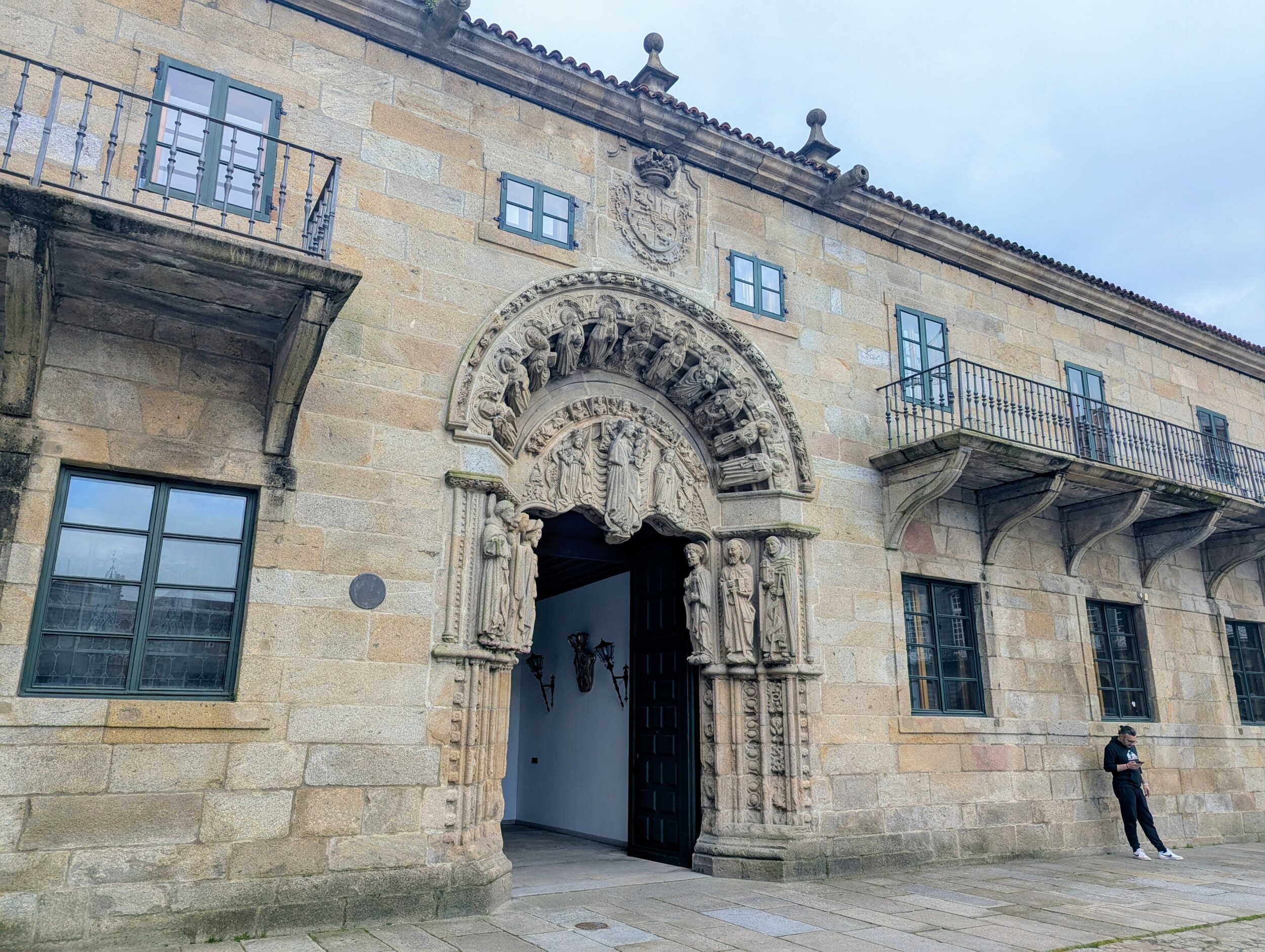
The most striking feature of the building is its doorway. It dates from the 15th century and was brought over from the old building: a Romanesque-Gothic structure with statues of saints and a Virgin Mary in the tympanum. The coat of arms of Archbishop Fonseca sits above it.
Today it’s the rectorate of the University of Santiago de Compostela, one of the oldest universities in Spain.
A Square Without Terraces
First-time visitors to the Praza do Obradoiro notice something: there are no café terraces. No rows of chairs, no branded parasols, no people ordering drinks with the cathedral as a backdrop. The square is empty, in the best possible sense.
That’s a deliberate choice. The Praza do Obradoiro isn’t a tourist square, it’s an arrival square. For pilgrims. The square has one function: arriving. And the city keeps it that way.
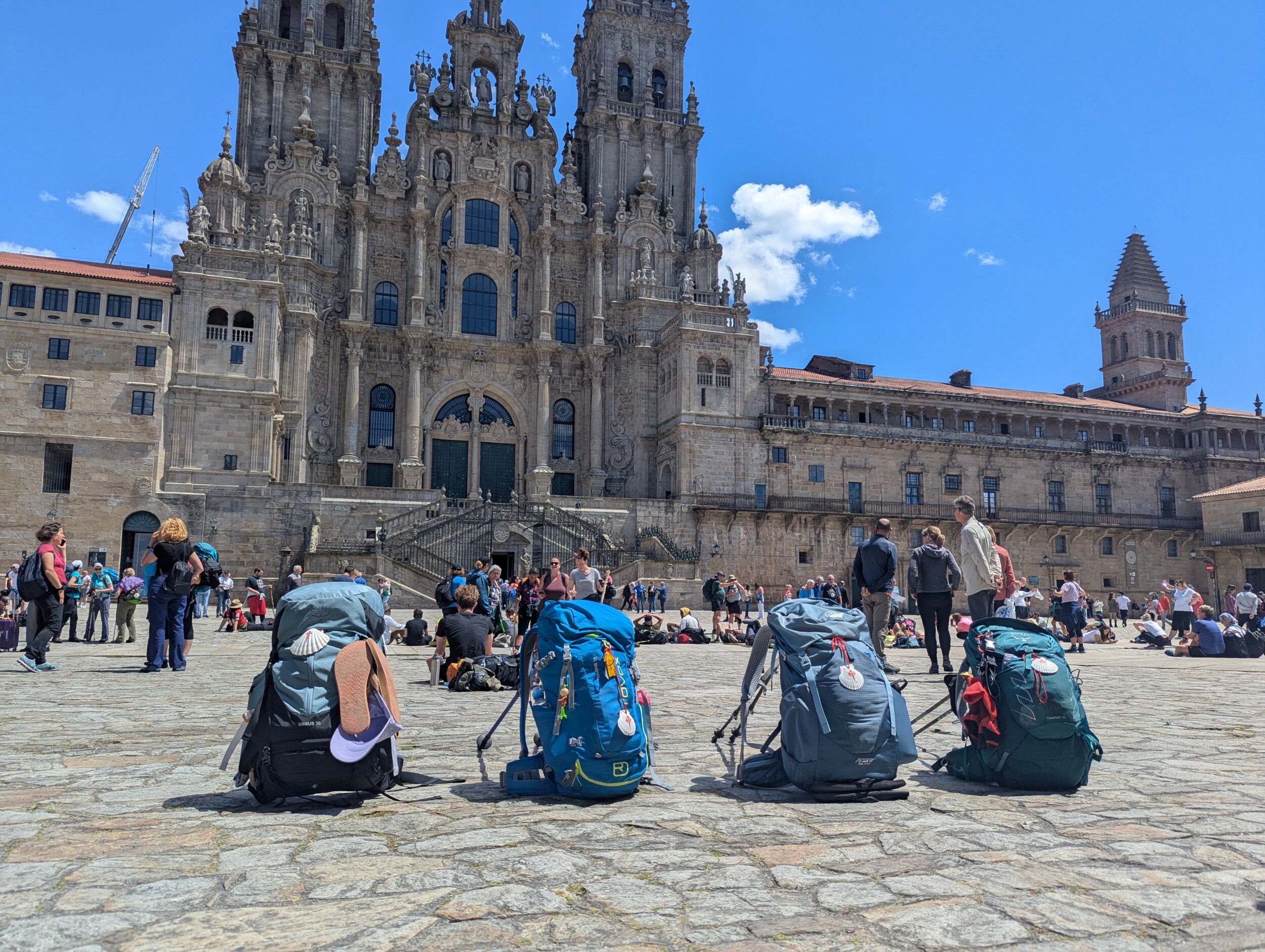
A small tourist train does occasionally pass through, picking up visitors at the edge of the square for a ride around the old town. A fairly matter-of-fact contrast to the exhausted walkers sitting in tears in front of the cathedral just steps away. Both worlds exist side by side, without getting in each other’s way.
Pilgrims planning to enter the city on horseback should contact the Local Police (tel. 092) several days before their arrival. They will inform you of the required route, the permitted times, and arrange an access permit allowing you to enter as far as Plaza del Obradoiro and briefly stop in front of the Cathedral. After that, the horses must be taken directly to pre-arranged stables or accommodation.
The Square Through the Day
Early in the morning, the square is quiet. Light falls low across the granite cobblestones, and the cathedral casts long shadows over the empty space. Pilgrims who’ve walked through the night arrive here in the morning stillness.
During the day, it fills up. The pilgrim’s Mass in the cathedral draws visitors, there are tour groups, solo walkers who’ve just arrived, and people spending an extra day in the city for their Compostela or the Mass.
After nine in the evening, the mood shifts. Quiet returns, music fills the arches of the city hall, and the cathedral is lit up. That’s when this square is at its most beautiful.
Kilometer Zero
In the middle of the square lies a granite plaque marking the unofficial zero point of the Camino de Santiago, the spot where all the routes converge. It notes that the Council of Europe declared the Camino the First European Cultural Route in 1987. A modest stone, really, for such a large movement.
You’ll always find pilgrims near that central stone. They stand next to it, touch it, take a photo of it or with it.
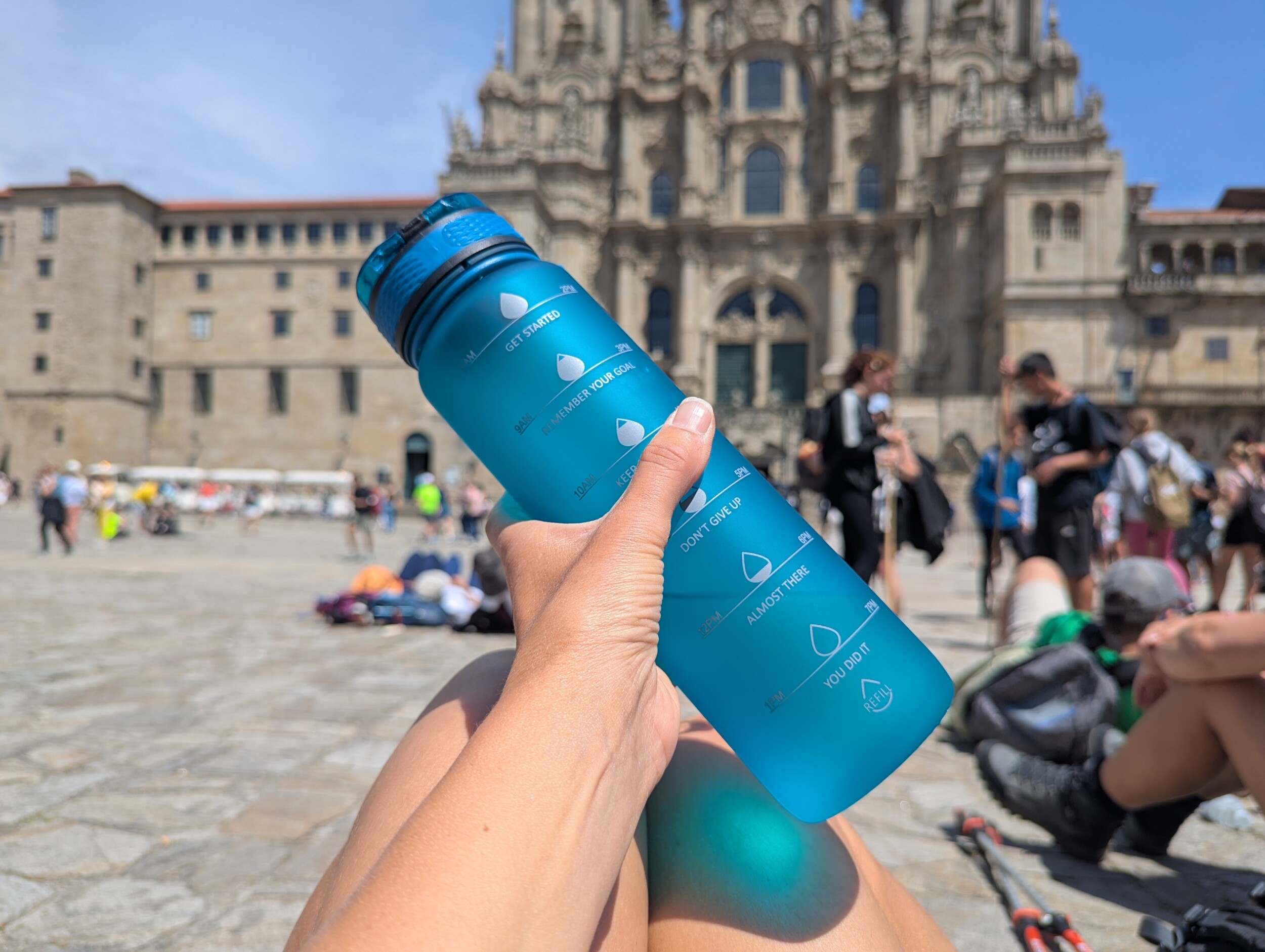
On every trip, I carry my own refillable water bottle. My mission is to help eliminate single-use plastic, and refilling instead of throwing away is one of the easiest ways for a traveler to contribute to that. A foldable bag for small purchases also saves unnecessary plastic waste along the way.
Related Reads
- The Pilgrim’s Office in Santiago de Compostela: how to collect your Compostela
- Travel guide for accommodation along the Camino de Santiago
- Is it safe to walk the Camino as a woman? Walking the Camino de Santiago solo
- Camino de Santiago packinglist
- 10 tips for arriving in Santiago in good health
This article contains affiliate links. If you book or purchase something through one of these links, we may receive a small commission at no extra cost to you.